SpaceX’s listing was the first time most traders got to see a pre-IPO perpetual meet its underlying. For months the perp had traded on a synthetic reference — an oracle aggregating last-known tender offer prices and secondary market valuations. The mark price diverged from that reference at times by hundreds of basis points. Within hours of the public listing, the perpetual and the listed equity were within a handful of basis points of each other.
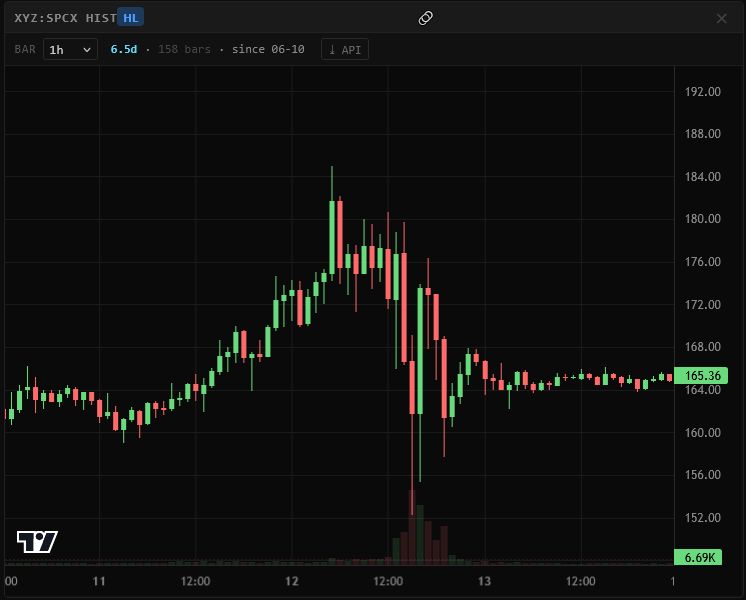
The convergence is the cleanest test we’ve had of what a pre-IPO perp is actually pricing. And the same question is open for the two largest pre-IPO names still trading as perpetuals — OpenAI and Anthropic — which have no listing date and no public market clearing price to converge to.
What the perp was pricing before the listing
Pre-IPO perps face a structural problem that listed-asset perps don’t: there is no real spot to anchor against. A standard crypto or commodity perp settles funding based on the difference between the perp mark and an index of public market prices. For a pre-IPO name, the “spot” doesn’t exist as a continuous public market — there’s only a sparse history of tender offers, accredited-investor secondaries, and last-round primary valuations.
The reference price that pre-IPO perps use is a synthetic construction. The exact methodology varies by venue, but the inputs are typically:
- Most recent tender offer price — when a company opens a buyback window for employees and early investors, that sets a price point. These happen quarterly at best for most private companies.
- Last primary round valuation — implied share price from the latest funding round. Stale by construction; updated only when the company raises.
- Secondary market reported prices — broker-dealers and platforms like Forge, EquityZen, and Hiive report secondary transaction prices. Liquid for some names; illiquid for others.
- Comparable-company adjustments — some references apply a public-comp multiplier to handle the time gap between the most recent observable price and now.
The perp’s mark price is a separate thing: it’s where the market clears, driven by demand for synthetic long or short exposure to the company. The basis between mark and reference — what the perp is trading at, versus what the oracle says the underlying is worth — is the market’s view on whether the synthetic reference is right.
That basis is informative but ambiguous. A positive basis (perp above reference) can mean any of:
- The reference is stale and the true value has moved up
- IPO expectations are being priced in at a higher level than the reference
- Long demand exceeds short supply (often the structural case in pre-IPO perps; the natural counterparty would be employees with shares, who don’t have a way to short into the perp)
- Speculation is pushing the mark beyond any fundamental view
You can’t tell which of these is dominant from the basis alone. Funding rate, OI skew, and the trajectory of the basis through time give you partial information, but the test only resolves when the synthetic meets the spot.
What the SpaceX convergence revealed
The mechanical part of the convergence is easy. Once SpaceX opened for public trading, the perp’s reference could update to the listed equity’s price. Any basis between perp mark and listed equity was now a clean arbitrage — long the cheaper side, short the more expensive side, hold for hours, take the spread. Without the structural friction that had kept the basis open during the pre-IPO period (no real shortable spot, no fast settlement vector), arbitrageurs closed the gap quickly.
The analytical part is harder, and more interesting. The convergence point tells you whether the synthetic reference had been tracking real value, or whether the perp’s mark had been the better signal all along.
If the listed equity opens close to where the perp mark had been trading and the reference had to chase up to meet it, the perp was the more accurate price discovery mechanism during the pre-IPO period. The reference’s reliance on quarterly tender offers and stale primary rounds had been lagging. The perp, despite having no real spot to anchor to, had absorbed enough information from secondary market chatter and order flow to anticipate the public market clearing price.
If the listed equity opens close to where the reference had been and the perp mark had to come down to meet it, the perp was over-pricing. The persistent positive basis had been demand pressure or speculation, not fundamental view, and the convergence was a deflation of that premium.
The actual SpaceX case appears to have been mostly the former — the perp mark had drifted up faster than the synthetic reference, and the listed equity opened closer to where the perp was trading than where the reference was. That’s a positive verdict on pre-IPO perp price discovery, at least for one of the most-watched names. It’s also a single data point.
What this implies for OpenAI and Anthropic
Both companies have liquid perp markets running on the same structural setup: synthetic reference oracle, no public spot, persistent positive basis at various points reflecting heavy long demand. Neither has announced an IPO date. The reference for each is built from the same kinds of inputs — recent tender offers (OpenAI’s employee tenders have been the largest in private market history; Anthropic’s are smaller but exist), last primary rounds, secondary market chatter.
The basis on each is interpretable but unresolved. Several things to watch:
The basis curve over time. A widening basis ahead of a perceived IPO catalyst (S-1 filing rumors, public commentary from the company, board changes) signals the market is increasingly pricing in a public listing at a higher level. A compressing basis without a corresponding change in the reference suggests speculative deflation. Both have happened on both names at different points.
Funding rate structure. Pre-IPO perp funding is structurally different from listed-asset perp funding because the natural short side is missing. Persistently high positive funding on the OpenAI and Anthropic perps reflects the imbalance: longs are willing to pay a real carry to hold synthetic exposure. The shorts who provide that liquidity are mostly market makers and basis traders, not natural sellers. That’s a different funding regime than ETH or BTC perps, and it produces different price dynamics over time.
The eventual convergence event. When either company announces an IPO date, the perp basis becomes a real-time poll on what the IPO will price at. The closer to the listing, the more the basis should compress toward zero — because the convergence event is imminent and arb becomes well-defined. Watch for the compression to start ahead of the listing, not at the listing itself, if the market is functioning.
Idiosyncratic risk. Until convergence, pre-IPO perps carry a tail risk that listed-asset perps don’t: the company could decline to go public, get acquired at a price meaningfully different from the reference, or stay private indefinitely. The basis has to price that distribution of outcomes, not just the central case. SpaceX’s listing removed that risk all at once. OpenAI and Anthropic still carry it.
The broader observation
Pre-IPO perps are a useful market design experiment. They give participants exposure to assets that have historically been gatekept — private market secondaries require accreditation, minimum check sizes, and waiting periods. The perp wraps the exposure in an on-chain instrument with continuous price discovery and standard derivatives mechanics.
The SpaceX convergence is the first clean test of whether the price discovery actually works. The early read is positive: the perp’s mark price appears to have anticipated the public market clearing price more accurately than the synthetic reference did. That’s a meaningful result for the design of the entire category.
For traders holding OpenAI or Anthropic perp exposure today, the SpaceX precedent is useful but not predictive. Different companies, different reference constructions, different demand profiles, different IPO probabilities and timelines. The basis on each name is the market’s current view, and the convergence event — whenever it comes — will be the verdict. Until then, the basis curve, the funding rate structure, and the relationship between mark and reference are the available signals.
For everyone else, the SpaceX case is worth noting because it answers a previously open question: a synthetic perpetual with no real spot anchor can, under the right conditions, do real price discovery. The synthetic and the spot converged. The harder question is when, and on which names, that result generalizes.